
An Autumn Itinerary for Couples in Portugal: The Slow Escape We Took Between Olive Groves, a Palacete and an Olive-Oil Massage

Three days in Trás-os-Montes and Alto Douro, told in the first person — a historic palacete in Alijó, an old olive mill turned restaurant in Torre de Moncorvo, an olive-oil couples massage at the Grapple, and the promise to come back in November for the olive harvest.
Before you begin: This itinerary is imagined — and told in the first person, as if we had lived it. The places, the hotels, the partners and the olive oil are all real. Call it fiction with an address. The journey is yours to take — at your own risk.
We arrived in Alijó at the hour when the Douro stops being a river and becomes light. September had finally given way to October, and the ridge across the valley had shed the tired yellow of late summer for a deeper gold, with the wind flipping the olive leaves the wrong way round. We were in no hurry. That, more than any view, was the luxury we had come for.
Our plan for three days fit in a sentence: stop. Two nights in two places with character, one old table, an olive mill turned restaurant, and a couples massage that exists nowhere else.
That is how it happened — and that is how we understood, without meaning to, what an autumn itinerary in Portugal actually is when you stop looking for anything and let the place come to you.
First night: a palacete in Alijó, at the heart of the Douro Wine Region
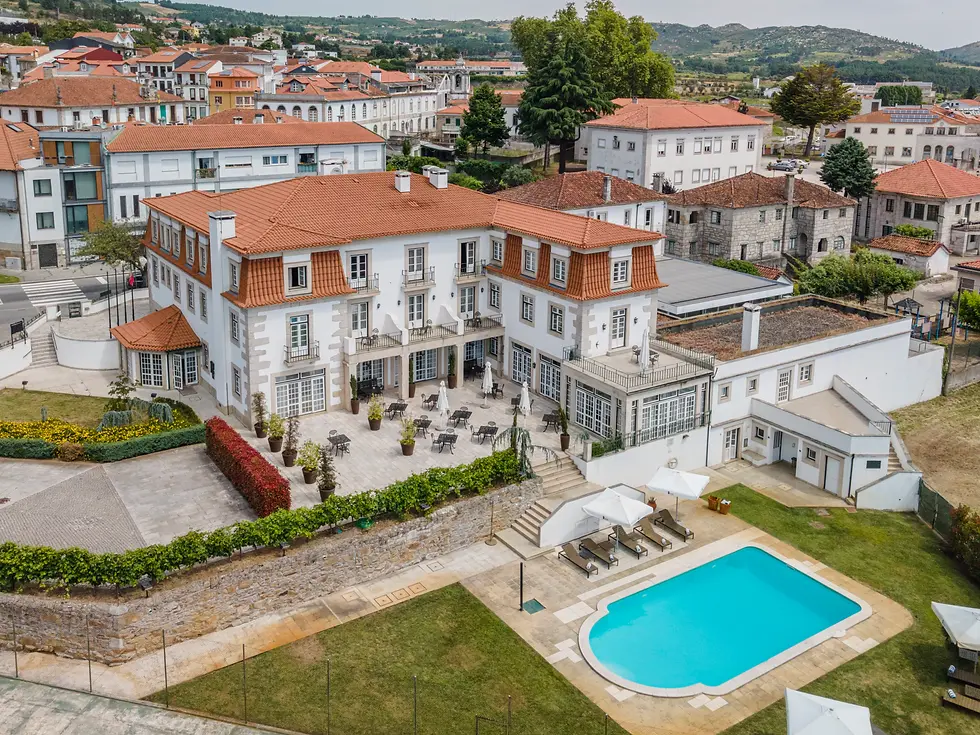
The Palacete Barão Forrester — Forrester Essence Douro Hotel — sits in the centre of Alijó, inside the Alto Douro Wine Region, a UNESCO World Heritage site. It is a four-star boutique hotel in a historic palacete, and it is one of those places that explain themselves better in the late-afternoon light than in any brochure. We dropped our bags, opened the window, and stayed silent, both of us, watching the inner courtyard. It was enough.
For dinner we stayed close and walked. Alijó gives itself back to you at the end of the day, at a rhythm that does not negotiate — the streets empty, someone is lighting a fire somewhere (the smell reaches you before the smoke), and you need a light jacket. We walked back to the palacete at the hour when the only thing left to do was to sleep with the shutters ajar. We set no alarm.
Saturday morning: the October light of the Douro
We woke to sunlight already on the window frame. Breakfast took its time, because we wanted it to. Then we set out — twenty minutes of slow driving with the curve of the vineyard terraces opening in front of us. We stopped where we felt like it, without dutiful photographs, just to look.
This is what October changes: in August, the Douro forces you awake at dawn; in October, the Douro belongs to you all morning. The olives are still in véraison — turning from green to purple, each in its own time. Three weeks until the mill starts running.
Lunch in Torre de Moncorvo: an old mill that became a table
We drove down to Torre de Moncorvo for lunch. We chose Restaurante O Lagar — set inside a working olive mill since 1983 — because we wanted to eat somewhere that knew what it was serving. The stone walls and the timber roof still tell the story of when olives were pressed there. Today they press dishes such as Bacalhau à Lagar and Posta de Vitela à Lagar, always with regional olive oil at their centre.
We took a corner table and did not order more wine — the whole afternoon was still ahead. He chose the veal; I chose the cod. We shared, as we always do. It was the kind of meal in which nobody checks their phone.
Before leaving, we crossed two streets to the shop of Dina Morais — Arte, Sabor e Douro, right next to the parish church. Dina is the only certified maker of the Amêndoa Coberta de Moncorvo, an almond with a Protected Geographical Indication. The process takes eight days, four hours in the morning and four in the afternoon, in a copper basin, with the almond bathed in a sugar syrup until its white shell forms. We bought a tin of covered almonds to take home and a bottle of regional olive oil from the shelves where she sells both, side by side. We did not need two shops — a sentence that, here, means a great deal.
Saturday afternoon: the olive-oil massage that only exists at the Grapple
We reached the Grapple Hotel & Spa in Carrazeda de Ansiães at the end of the afternoon. It is a four-star hotel that has, deliberately, decided to be a place of rest — not a place of programme. We checked in slowly. We asked about the massage. It was booked.

This is the experience that brought us here: a couples massage, made with regional olive oil. It is not a spa metaphor — it is literal. The olive oil enters the room, enters the skin, enters a ritual that lasts as long as it needs to. We came out silent, both of us, hair still wet, with no wish to talk about what we had just felt. He fell asleep in his robe. I read one chapter of a book I had carried for three months and never opened.
For dinner, we went down to the Grapple Restaurante. The kitchen pairs local tradition with sophisticated dishes made from the estate's own kitchen garden — and that is the difference, because in Trás-os-Montes the garden behind the restaurant is not decoration, it is the raw material of the plate that reaches you. We drank the local wine the waiter recommended. We went back to our room at the hour when a fireplace, somewhere in the hotel, began to crackle louder than the conversation.
Sunday: the little that makes the difference
Sunday was the shortest day — and the most complete. Breakfast without a set hour. A short walk through the centre of Carrazeda de Ansiães, its stones just waking. Then, before heading home, a small detour: we drove up to Vilas Boas (Vila Flor), where the viewpoint on the Monte de Nossa Senhora da Assunção stretches the landscape across roughly one hundred kilometres. It is the largest Marian sanctuary in Trás-os-Montes, and one of the region's widest viewpoints.
We sat there for fifteen minutes, without speaking. It is strange how a high place explains everything that happened down below. We understood, then, what the weekend had been: an initiation. An invitation from the territory to come back.
Why autumn is, in Portugal, the season for couples
The OECD 2026 report confirmed what those who have travelled for a while already knew: demand in Portugal is shifting to spring and autumn, as Mediterranean summers become less tolerable. In Trás-os-Montes and Alto Douro, that shift is an old advantage.
Temperatures fall to 18–25 °C at mid altitudes. The low light turns every olive grove into a painting. And the small, family-run inns and hotels — most of them with only a handful of rooms — again have time to welcome you unhurriedly.
Autumn is the season that returns these places to those who look for silence à deux. No restaurant waiting lists, no weekends booked to the last bed, no rush for the ideal hours of the day. It is the season in which olive oil tourism becomes, in fact, a couples experience — because everything slows down at the same time.
And if you come back in November, you find the harvest
We drove back to Porto on Sunday night with one decision made along the way: come back in November. Between late October and all of November, the olive groves of Trás-os-Montes fill up with hands, sheets, nets and conversation. Many producers in the Azeite a Norte network open that morning to whoever wants to take part — pick with a pole, follow the olive to the mill, taste the oil while it is still warm. If this itinerary reads to you like a promise, keep a week in your calendar. We published, on 2 September, a dedicated guide — Olive Harvest 2026: A Guide to Taking Part in Northern Portugal — with the calendar, itineraries and what to bring.
How to plan your own autumn escape for two
This is our account. Yours may be different, with different names and different days — and the territory has, for that, an entire network. Explore the experiences the Azeite a Norte network publishes at azeiteanorte.pt/en/experiences. Meet the producers at azeiteanorte.pt/en/producers and contact directly the one whose voice speaks to you — each producer has their own rhythm and their own way of welcoming.
If you cannot find what you are looking for, write to us at info@azeiteanorte.com. We will help whenever we can.
The olive oil of Trás-os-Montes cannot be explained. It has to be tasted.
One last note (same as the first, with the patience of someone who reached the end): This itinerary was imagined by us, Azeite a Norte, based on the real network of accommodations, restaurants, producers and landscape that exists in Trás-os-Montes and Alto Douro. If you decide to live your own version, write to us — the next one may be yours.
Sources
OECD, «Tourism Trends and Policies 2026» — climate and demand shift to shoulder seasons.
Restaurante O Lagar — Torre de Moncorvo (operating since 1983 inside a former olive mill).
Grapple Hotel & Spa — Carrazeda de Ansiães (spa experiences with regional olive oil; Grapple Restaurante with kitchen-garden produce).


Comments