
When the farm welcomes too: farm stays, women, and the new economics of olive oil tourism


For a long time, making olive oil and welcoming visitors seemed like two separate lives — one turned towards the land, the other towards people. Today, in Portugal’s northern interior and across the world, those two lives are coming together. The reason is simple: when a farm opens its door to those who want to know it, it no longer depends only on what the harvest earns. It gains a second income stream instead of one. For many families, it is that second door that keeps the first one open.
This piece is for anyone who has an olive grove, a mill or a house out in the countryside — and still hesitates. For anyone who looks at an olive and finds it unthinkable that someone would pay to pick it with them. The evidence, by now, leaves little room for doubt.
The international evidence: what the numbers already show
Let’s start with the question that matters: does it pay off?
In the United States, a recent Airbnb report offers an answer that is as uncomfortable as it is clear. In 2024, the median family farm lost money on farming alone. In the same period, the producer who opened their farm to guests earned from that activity roughly a fifth of the household’s total income. It is not a luxury extra — it is often the difference between carrying on and giving up.
And it is not an isolated case. Demand for farm stays has nearly quadrupled over the past decade, and hosts’ earnings have grown close to 400% since 2018. What is more: where a welcoming farm appears, the surrounding local tourism economy grows about 15% faster than in comparable areas without one. A single door that opens can pull an entire village onto the map.
This is not a distant phenomenon. It is why major platforms and farming organisations are beginning to create dedicated support for those who want to take this step — a sign that agritourism has stopped being a niche and become a serious rural-development bet.
Combining the two activities multiplies profitability
The secret is not choosing between producing and welcoming. It is joining the two — because each one adds value to the other.
The visit transforms the product. Someone who tastes the oil at the mill, with the grove in view, takes home a bottle with a name, a face and a story — and grants it a value they would never give it on an anonymous supermarket shelf.
The product transforms the visit. A table serving the house’s own olive oil, bread, honey and regional charcuterie is an experience no generic hotel can copy. Abroad they sum it up in one phrase: the farm becomes the dining room.
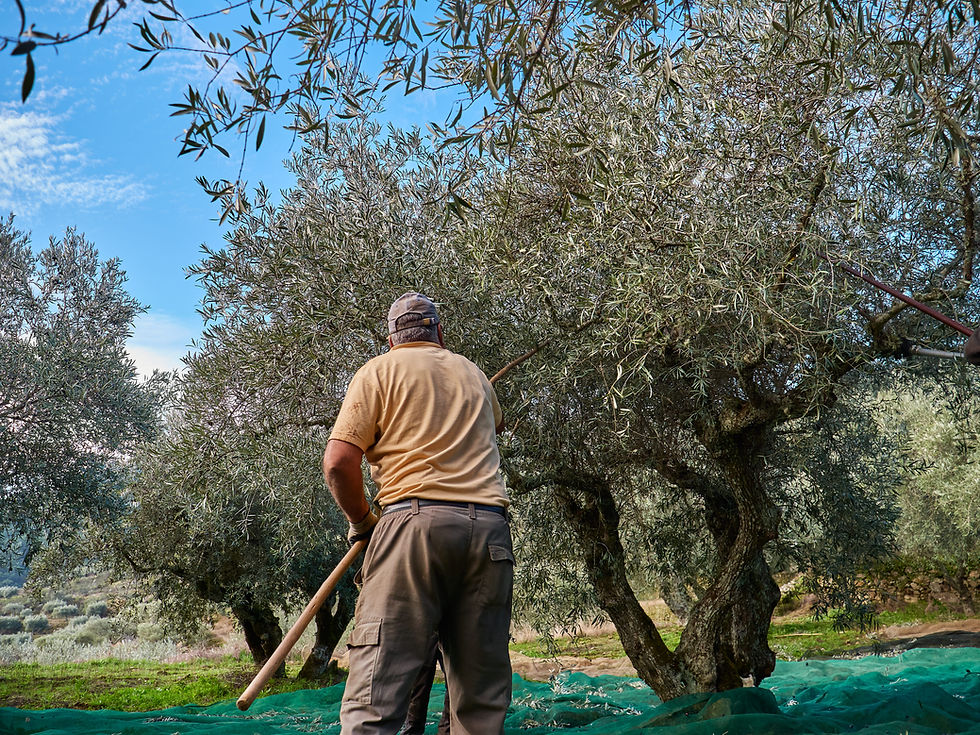
There is a third ingredient, and it is the most powerful of all: participation. Today’s visitor does not just want to watch — they want to take part. To pick the olives, follow the milling, taste the oil straight from the mill, learn to pair it at the table. In Trás-os-Montes and the Alto Douro, the harvest, between October and December, is the most immersive experience of the year — and also the easiest to turn into a tourism product, because it already happens every year. You only have to open the door to it.
Women stepping into a male-dominated industry

Within this shift there is another, quieter one. In the U.S. report, 70% of those welcoming visitors to their farm are women — while women make up only 36% of all agricultural producers. Tourism has become the door through which many step in, in their own name, into a sector that for generations kept them in the shadows.
It is not that they were not there.
They were — in management, in the kitchen, at the front desk, in the decisions. What they lacked was the stage. The tourism experience gives them that stage: it is often the woman of the house who imagines, tells and leads what the visitor takes away as a memory.
And there is the other side of the coin — the traveller’s side. In most couple trips, it is the woman who researches first, chooses and books. Among senior travellers, almost all decide their household’s destination; and three in four travellers on culture-and-nature experiences are women. In other words: it is increasingly women who create these experiences — and mostly women who choose them. Those who welcome and those who decide end up meeting.
In our territory, this story already has a face. The Casa d’Abó Anica farm stay is run by women, with a proven track record. And among those who make the oil there are more and more women-led projects — many of them young — from Maloio to Quinta do Soutinho, from Olival das Fontes to Quinta Mourisca, in Alfândega da Fé. They are not exceptions: they are the face of a generation reinventing the Trás-os-Montes farm.
Mediterranean olive country has already joined the circuit
You do not need to cross the Atlantic to see this working. In Spain, Italy and Greece, the September and October harvests have become a tourism product built on participation: in Tuscany and Umbria, the visitor picks grapes by hand and lunches on the estate; in La Rioja, the vendimia is the main event; in the Peloponnese, you step into family traditions. And, increasingly, the olive joins the grape: grove walks, oil tastings, production demonstrations and meals built around freshly made olive oil.
These are our neighbours — and also our competitors. The good news is that they do exactly what Trás-os-Montes and the Alto Douro can do, often with an authenticity other destinations have already lost. Here, when you visit a producer, it is the producer themselves who welcomes you — not a guide hired for an experience designed for hundreds of people. That human scale, not industrial size, is our trump card.
Olive oil tourism in our territory: where to begin
Trás-os-Montes and the Alto Douro is Portugal’s second-largest olive-growing region — close to 79,000 hectares of olive groves across seventeen municipalities, many with centuries-old dryland trees found nowhere else. It is also a territory where olive oil tourism is not a single product but a year-round ecosystem of experiences: almond blossom in spring, the harvest in autumn, gastronomy in winter.
Starting does not require a big investment or perfect infrastructure. You begin with what you already have:
an olive oil tasting at the mill, with the grove in view;
a meal at the table, with the produce of the house and the region;
a room, a house or a space for those who want to stay more than a day.
And, above all, you begin in partnership. A producer, an accommodation and a restaurant together offer what none of them could alone: a complete experience. That is already happening across the network — from the "From the Grove to the Geopark" olive harvest in Macedo de Cavaleiros, to the welcome of Casa de Campo dos Távoras in Mirandela, or Monte da Bela Vista in Podence, to Bétula Studios, for those seeking immersion in nature.
There is one more argument, at once commercial and about purpose: every visit helps keep the traditional dryland olive grove alive. The centuries-old trees that give our finest oils only stay standing while they remain economically worthwhile. The visitor who gets to know them, tastes their oil and takes a bottle home becomes, without realising it, part of their preservation.
For those starting out, or hesitating: the invitation
If there is one conclusion to draw from all this, it is this: combining production and tourism is not a distraction from farming. It is, increasingly, what makes farming possible. The demand exists, it is growing, and it comes closer to us with every season. And our territory has what money cannot buy: a living landscape, unique varieties, time and truth.
The Azeite a Norte platform exists to connect those who produce, those who host and those who cook — and to put the territory on the map of those looking for this kind of journey. If you have an olive grove, a mill or a house in the countryside and have ever thought "this could be an experience too", you probably already have more than you need to begin.
Talk to us. And to follow the next stories, trends and opportunities in northern olive oil tourism, subscribe to our newsletter.
A note on sources: the international figures draw on Airbnb’s "Farm to Stay" report (US, 2025) and on European harvest-tourism trends documented in September 2026. The indicators on women’s travel decision-making come from Azeite a Norte’s own gender analysis.


Comments