
February in the Olive Groove: the hands that shape the future

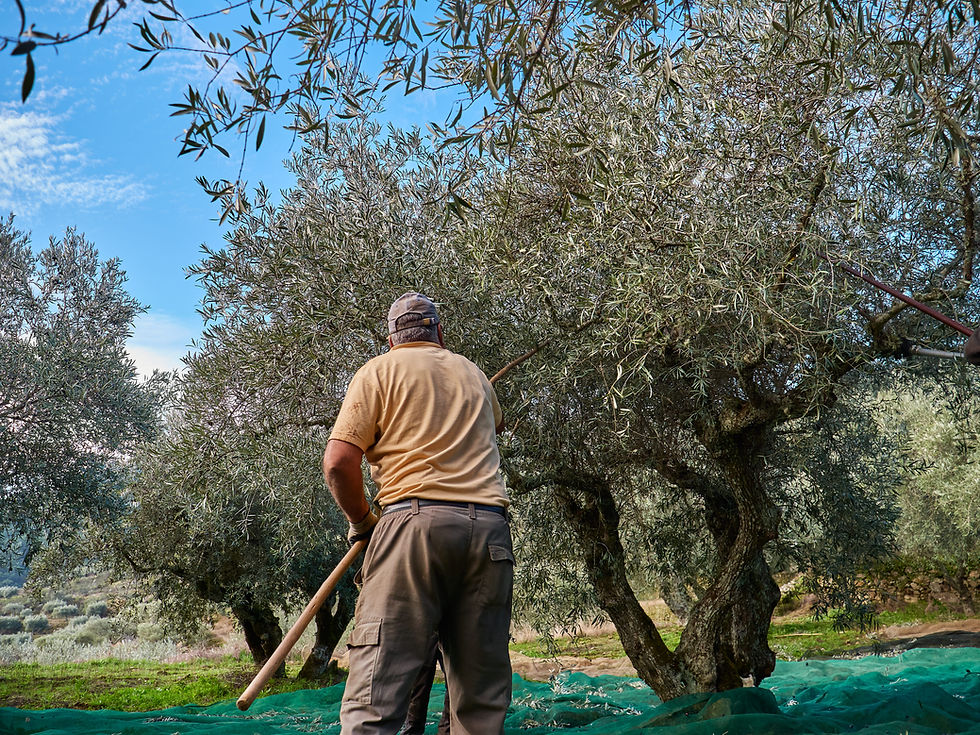
After January brings the silence of deep rest, February arrives in the olive grove with sharp tools and experienced hands. This is the month when the olive grower converses with each tree, deciding which branches stay and which go—a dialogue between tradition and knowledge that will shape the next harvest.
While the pruning shears shape the future of the olive trees, in the villages of Trás-os-Montes, the Caretos take to the streets in ancestral rituals that also celebrate renewal: the end of winter and the promise of approaching spring.
February is the month of hands that shape—be it the crown of the olive tree or the destiny of the community.
Olive Pruning: An Ancient Art That Requires Wisdom
In Portugal, olive tree pruning traditionally takes place between February and April, with February being the month of greatest intensity in the olive groves of Trás-os-Montes. This period coincides with the end of the vegetative rest, when the olive tree is ready to receive the intervention without suffering too much stress [1].

Pruning is not just an agricultural technique—it is knowledge passed down from generation to generation, a conversation between the olive grower and the tree that demands observation, experience, and respect. Each cut has consequences; each branch removed or kept influences the next harvest.
Recent studies estimate that the northern interior of Portugal loses annually more than 20% of the olive production that could be obtained if a pruning regime appropriate to the tree's physiology were implemented [2].
In Trás-os-Montes, many olive growers adopt the "three-cut pruning" system, a simplified but extremely effective technique that, when well applied, can increase average annual production by 30% and reduce labor costs [3].
What is the purpose of pruning: the essential objectives
Pruning olive trees serves multiple fundamental purposes for the health and productivity of the tree:
Eliminate unproductive and "thief" branches: branches that grow vertically, called "thief" branches, do not produce olives but steal energy from the tree. Removing them directs the olive tree's energy to the productive branches [1;4].
Encouraging the growth of new branches: the olive tree bears fruit on the branches of the first year — those that grew in the previous spring and summer. It is therefore essential to encourage the appearance of new branches annually through proper pruning [1;5].
Improving light and ventilation: opening the canopy allows sunlight to reach the interior of the tree and air to circulate, reducing humidity and the risk of fungal diseases. A well-ventilated olive tree is a healthier olive tree.
Facilitating harvesting: by guiding the olive tree into the appropriate shape and controlling its height, pruning makes harvesting easier, safer and more efficient — an essential factor in traditional hillside olive groves [1].
Removing diseased or damaged wood: eliminating branches affected by diseases such as olive tuberculosis (caused by the bacterium Pseudomonas savastanoi) is essential, since there are no effective chemical treatments for bacteria — pruning is the only solution [1;6].
How to prune: the knowledge of experienced hands
Pruning olive trees requires sharp, clean tools—pruning shears for thin branches, saws for thicker branches—and, above all, knowledge of the tree's physiology.
The principles are clear: start by removing dead, dry, or diseased branches; eliminate branches that grow inwards; cut branches that compete with each other for the same space; reduce the height if necessary to facilitate harvesting; and perform a final cleanup, removing all pruning debris from the olive grove [1].
But pruning goes beyond technique: it is also intuition, sensitivity, and reading the tree. Each olive tree has its own history, its own shape, its own productive behavior. The experienced olive grower knows that a well-pruned tree is not one that has suffered many cuts, but one that has been pruned the minimum necessary to achieve the defined objectives.
As the saying goes in Trás-os-Montes: "He who tills the olive grove asks for fruit; he who fertilizes it asks insistently; he who prunes it forces it to yield olives."
February in the Villages: Carnival that renews the land
While the olive groves are shaping the future of the next harvest, in the villages of Trás-os-Montes, February is the month of Entrudo — an ancestral ritual that marks the end of winter and celebrates the renewal of agricultural cycles.

The Entrudo Chocalheiro de Podence, recognized since 2019 as Intangible Cultural Heritage of Humanity by UNESCO, is the most vibrant expression of this tradition. For four days (from Saturday to Carnival Tuesday), the Caretos — masked figures dressed in colorful fringed suits and brass or wooden masks — take to the streets to the thunderous sound of rattles and bells [7].
The Caretos personify supernatural beings linked to the rhythms of the earth, representing the inversion of the social order, fertility and the passage to a new productive cycle. They are not figures created to entertain tourists — they exist because they have always existed, inherited from generation to generation as part of the Transmontane identity [7;8].
This tradition, which dates back to pre-Christian times and has roots in Roman celebrations of the end of winter, shares the same logic with olive grove work: celebrating the end of one cycle and preparing for the arrival of another. While pruning renews the olive tree, Carnival renews the community [8;9].
Other villages in Trás-os-Montes also maintain unique rituals: in Santulhão, the "Judgment of Entrudo" takes place, where straw dolls symbolizing the evils of winter are judged and burned in the public square; in Vinhais, the Máscaros take to the streets with ritualized behaviors; in Lazarim, the carved wooden masks passed down from father to son come to life in the parades [10].
The deep connection between pruning and tradition
The connection between olive tree pruning and Carnival rituals may seem distant, but both share the same essence: necessary renewal, the pruning that allows rebirth, the wisdom of knowing when to intervene.
Just as the olive grower removes branches so that the tree produces better, the community symbolically "removes" the ills of winter so that spring arrives with renewed strength. Both gestures—the pruning in the olive grove and the ritual in the villages—are expressions of an agrarian culture that understands cycles, respects time, and celebrates transformation.
February to feels
For those visiting Trás-os-Montes and Alto Douro in February, this is a month of duality: the silent work in the olive groves, where pruning shears converse with the ancient olive trees, and the explosion of color, sound, and energy in the villages during Carnival.
It's possible to walk through olive groves where olive growers share ancestral knowledge of pruning, understand why each cut matters, feel the weight of tradition in the hands that shape centuries-old trees. And, a few kilometers further on, find entire villages transformed into stages for rituals that have spanned centuries.
February is also the perfect month for olive tourism experiences that combine agricultural work and cultural heritage — discover more at azeiteanorte.pt/experiencia
On the tables, the new olive oil continues to shine: in vegetable soups, roasted cod, pork from recent slaughters, accompanied by warm bread and wine that warms the body.
February is a time to celebrate the abundant table before the Lenten austerity that approaches.
The hands that shape the future
February teaches us that renewal requires courage—courage to cut, to decide, to trust that less can be more. Pruning, like the rituals of Carnival, is an act of faith in the future: believing that the olive tree will respond to the cuts with renewed vigor, that spring will arrive after winter.
In the olive groves of Trás-os-Montes, where millennial olive trees coexist with equally ancient traditions, February is the month that reminds us that caring for the land is also caring for memory, and that shaping the future involves honoring the past.
🫒 Follow along with us the olive tree's cycle month by month—in March, we will see how the olive tree definitively awakens and prepares for flowering.


Comments