
When the Snow Paints Trás-os-Montes White: The Magic of Winter in the Northern Interior

January 2026 brought back to Trás-os-Montes and Alto Douro the abundant snow that had not been seen for a long time. Two consecutive meteorological depressions covered ancestral villages, centuries-old olive groves and majestic mountains in white, reminding us that the northern interior is much more than olive oil and traditions — it is also a winter destination of rare beauty.

January 2026 will forever be etched in the collective memory of Trás-os-Montes as the month when snow once again painted the landscapes of the northern interior white. First came Depression Ingrid on the 23rd and 24th, bringing what IPMA classified as the heaviest snowfall of the last decade. Then, just three days later, Depression Kristian once again covered the highlands of Trás-os-Montes and Alto Douro with snow [1,2,4].
From Vinhais to Bragança, from Miranda do Douro to Macedo de Cavaleiros, the snow fell generously, accumulating at altitudes above 700-800 meters and transforming centuries-old villages, dormant olive groves, and mountains into fairytale settings. For a region accustomed to harsh cold—but where snowfalls of this magnitude have become rare in recent decades—it was a magical moment of rediscovering the winter identity that has always characterized the "Wonderful Kingdom" [1].
The Magic of Snow in Trás-os-Montes: More Than Just a Meteorological Phenomenon
When one speaks of snow in Portugal, the immediate thought is of the Serra da Estrela mountain range. And rightly so: the highest point in mainland Portugal, with its ski resort, has dominated the Portuguese imagination for decades when the subject is a white winter.
But the snow that covered Trás-os-Montes and Alto Douro this January—not once, but twice in less than a week—served as a reminder of something fundamental: the northern interior has winter landscapes of unique beauty, shaped not only by the snow itself, but by the context in which it appears.
Here, snow is not just a tourist attraction: it is part of the collective memory of villages that, for centuries, have learned to live with harsh winters. It is the element that transforms centuries-old olive groves into natural sculptures, that covers schist houses with white blankets, that turns each smoking chimney into a Christmas postcard that extends beyond December.
The Montesinho and Nogueira mountain ranges, the Bornes mountain range, the Mirandês Plateau, the Marão mountain range, the Alvão Natural Park, and the highlands of Montalegre and Boticas offer landscapes where snow stretches across deep valleys, stone villages, and olive groves that have endured for centuries, creating a unique aesthetic—different from the Serra da Estrela, but equally spectacular and, in many cases, more authentic.
The Scenery Revealed by the Snow
When the snow began to fall on the night of January 23rd, villages like Montesinho, Varge, Rio de Onor, França, Gimonde, and dozens of others awoke enveloped in a white silence. The stone and granite houses, with their dark slate roofs, were covered in immaculate blankets. Smoke from the fireplaces rose slowly into the sky, drawing grey lines against the absolute white of the landscape.
Three days later, when the snow returned with Storm Kristian, the scene repeated itself—but this time with the collective awareness that 2026 was being generous to the Transmontane winter. The village schools closed because the snow made safe transport impossible [3]. And the families, accustomed to the cold but surprised by the abundance, went out to record the rare moment.
The Transformed Olive Groves
The olive groves—absolute protagonists of the Trás-os-Montes landscape for most of the year—have taken on a new, almost mystical dimension under the snow. The centuries-old trees, with their trunks twisted by time and the harsh climate, have become natural sculptures dressed in white.
To see a Trás-os-Montes olive grove covered in snow is to witness resilience embodied in the landscape. These are the same olive trees that withstand the biting cold of January, that bloom in spring, that ripen olives under the scorching September sun, that offer liquid gold in the autumn harvests. Now, resting under the white blanket, they silently prepare for the next cycle.
It is an image that few have the privilege of seeing—and that only January, in especially generous years like 2026, offers.
The Joy of the Villages

The snow also brought joy. Children made snowmen, threw snowballs, and slid down improvised slopes. Families took photographs that will forever remain in their memories and albums. Social media was filled with images documenting an increasingly rare phenomenon—real snow, the kind that covers entire fields, accumulates on walls, and completely transforms the landscape.
Snow in Trás-os-Montes is not just a meteorological event—it's a bridge between generations, a link to the past, a confirmation that despite climate change, the winter in Trás-os-Montes still knows how to be truly winter.
More Than Snow: A Complete Experience
What distinguishes the winter in Trás-os-Montes from other experiences is not just the snow — it's the cultural, gastronomic, and human context in which that snow appears.
Villages that Live in the Snow
While other tourist destinations are well-structured, with large flows of visitors concentrated in specific areas, Trás-os-Montes and Alto Douro offer a more intimate and authentic experience: villages where snow is part of the collective memory, where fireplaces warm centuries-old stone houses, and where the genuine hospitality of the northern people is evident in every conversation, in every dish served at the table.
Montesinho, at about 1000 meters altitude, is a perfect example: typical Trás-os-Montes villages with granite houses adapted for rural tourism, where it is possible to wake up to a white landscape at the door and be greeted with a breakfast where local olive oil takes center stage.
Gastronomy that Warms the Soul
If snow is the backdrop, the cuisine of Trás-os-Montes is the star, warming body and soul. Nothing beats a wild boar stew, a traditional Trás-os-Montes stew, migas with pork ribs, or pork chops roasted over embers to face the harsh cold of the northern winter.
And, of course, olive oil—always olive oil. Even in January, when the olive groves rest under the frost, the new olive oil from the recent harvest continues to be generously poured over roasted vegetables, boiled cod, steaming soups, and warm cornbread fresh from the oven. It's the golden thread that unites all Trás-os-Montes meals, the flavor that defines an identity.
Winter Festivals and Caretos
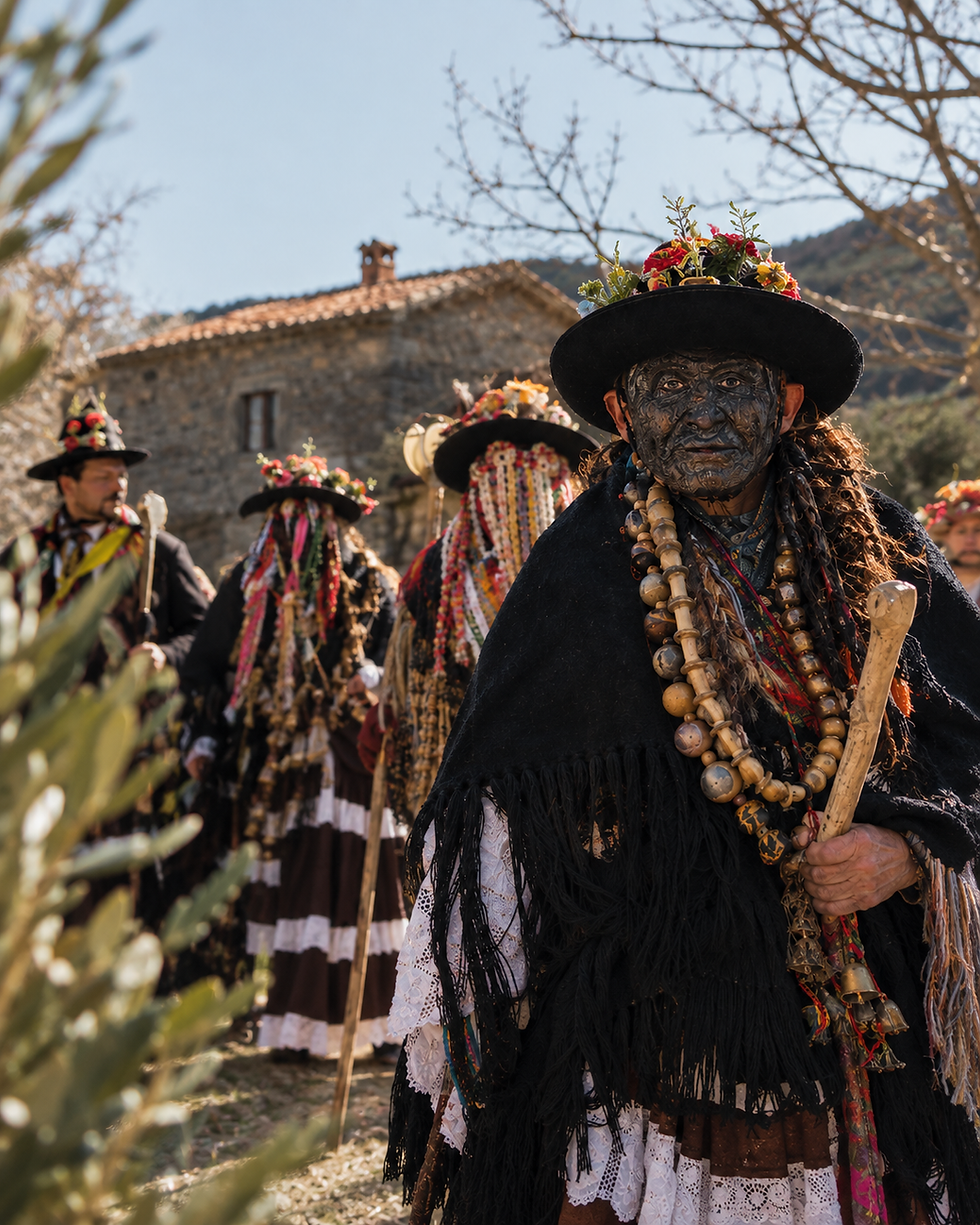
January is also the month of Winter Festivals in Trás-os-Montes and Alto Douro. Even with snow hindering access, villages like Varge, Ousilhão, and many others keep alive the traditions of the Caretos — masked figures who roam the streets in an ancestral ritual of renewal and fertility.
Seeing the Caretos jumping in the snow, their rattles echoing through the white valleys, is an experience that no ski resort can replicate. It is living culture, it is intangible heritage that has withstood the centuries — and which gains even more strength when the landscape is painted white.
Where to Experience the Snow in Trás-os-Montes
For those seeking to live this unique experience, Trás-os-Montes and Alto Douro offer multiple options:
Montesinho Natural Park: With altitudes exceeding 1000 meters in many areas, the park is a prime location for seeing snow. Villages like Montesinho, França, and Gimonde offer quality rural accommodation and access to stunning hiking trails.
Miranda do Douro and the Mirandese Plateau: Snow frequently blankets this region of arid landscapes and stark beauty, creating striking visual contrasts.
Serra do Marão and Alvão Natural Park: Located between the Douro Litoral and Trás-os-Montes regions, these mountain ranges offer spectacular views and frequent snowfall above 1000 meters.
Bragança and the municipalities of Northeast Trás-os-Montes: Macedo de Cavaleiros, Vinhais, Vimioso — all these municipalities are well acquainted with snow and offer authentic Trás-os-Montes winter experiences.
Discover more accommodations and authentic experiences in Azeite a Norte and plan your next winter getaway.
The Challenge: Showcasing Trás-os-Montes and Alto Douro in Winter
The snow of January 2026 is an opportunity worth sharing. For too long, winter tourism in Portugal has focused exclusively on the Serra da Estrela mountain range, leaving in the shadows a region that has so much—or more—to offer in terms of authenticity, landscape, and cultural experience.
Trás-os-Montes and Alto Douro have all the ingredients to establish themselves as a top-tier winter destination:
✓ Unique landscapes: centuries-old olive groves transformed by snow, schist and stone villages that seem straight out of ancient tales, majestic mountain ranges and deep valleys where the silence is absolute.
✓ Cultural authenticity: Living traditions, ancestral festivals that are still celebrated, a unique language (Mirandese), and a strong identity that has withstood the centuries.
✓ Exceptional gastronomy: Food that warms the soul — steaming stews, roasted meats, artisanal sausages — all seasoned with the finest PDO olive oil of superior quality.
✓ Genuine hospitality: Welcoming people who receive visitors not as tourists, but as guests who deserve the best the house has to offer.
✓ A more relaxed experience: Less mass tourism, allowing you to experience the snow in a more intimate and authentic way.
The point is not to compete — each destination has its own characteristics. The point is to show that Portugal has more than just a snow destination, and that Trás-os-Montes and Alto Douro offer something different: an experience where snow is just one part of a much larger whole that includes culture, history, gastronomy and, above all, humanity.
January in Trás-os-Montes and Alto Douro: Much More Than Snow
The snow that blanketed Trás-os-Montes and Alto Douro in January 2026—twice, generously—was more than just a meteorological phenomenon. It was a reminder of this region's potential, an opportunity to show the country that the interior north also knows how to winter, an invitation to rediscover landscapes that many had forgotten.
Here, snow doesn't appear in isolation: it's accompanied by ancient olive groves resting, schist villages where time seems to slow down, traditions still celebrated with the same intensity as centuries ago, comforting gastronomy, and people who know how to welcome with their hearts.
It's a complete, profound, transformative experience—and one that deserves to be lived by anyone seeking a truly Portuguese winter.
So, when you think about experiencing a snowy winter, remember: Trás-os-Montes and Alto Douro are here, with their historic snowfalls (when nature allows), their olive groves silvered by frost, their villages where every fireplace tells a story, and the unparalleled hospitality of their people.
"When snow covers the olive groves of Trás-os-Montes and smoke rises from the chimneys of the stone houses, we realize that the true Portuguese winter is much more than snow — it is memory, it is culture, it is the essence of a territory that resists time and that, even under the absolute white of January, keeps its golden identity alive: that of olive oil, of the olive tree, of the land that never forgets."
Come discover the authentic winter. Come feel the cold that warms the soul. Come explore Trás-os-Montes and Alto Douro — where the snow, when it arrives, is always accompanied by magic.
Hashtags: #TransmontaneSnow #TrásOsMontes #AltoDouro #WinterTourism #SnowInPortugal #OliveOilInTheNorth #AuthenticWinter #VillagesOfPortugal #NaturalHeritage #RuralTourism #TransmontaneGastronomy #WinterFestivals #SnowyOliveGroves #AuthenticPortugal #WinterTrip
References:
[1] RTP Notícias - "Maior nevão da última década em Trás-os-Montes": https://www.rtp.pt/noticias/pais/maior-nevao-da-ultima-decada-em-tras-os-montes_v1712487
[2] RTP Notícias - "Depressão Ingrid. A evolução do mau tempo em Portugal ao minuto": https://www.rtp.pt/noticias/pais/depressao-ingrid-a-evolucao-do-mau-tempo-em-portugal-ao-minuto_e1712291
[3] Rádio Brigantia - "Escolas do meio rural em Bragança fechadas e transportes públicos suspensos": https://www.brigantia.pt/noticia/escolas-do-meio-rural-em-braganca-fechadas-e-transportes-publicos-suspensos
[4] RTP Notícias - "Depressão Kristin. A evolução do mau tempo em Portugal ao minuto": https://www.rtp.pt/noticias/pais/depressao-kristin-a-evolucao-do-mau-tempo-em-portugal-ao-minuto_e1713498
[5] Euronews - "Tempestades são cada vez mais frequentes. Portugal na rota da Kristin": https://pt.euronews.com/green/2026/01/27/comboio-de-tempestades-mau-tempo-varre-a-europa-em-portugal-chegou-a-vez-da-depressao-kris
Note: Note: This article was written based on the meteorological events of January 2026 (storms Ingrid and Kristian) and news coverage from RTP, Rádio Brigantia, Euronews and other credible sources.


Comments