
The Ancient Olive Oil Mill of Cortiços: Where the Stones Still Tell Secrets of Olive Oil

There are places where time crystallizes. The Olive Oil Museum Centre - Solar dos Cortiços, in the village of Cortiços, is one of those rare spaces where we can literally touch the past. It's not an ordinary museum — it's a time capsule that preserves, intact, the way our great-grandparents transformed olives into liquid gold.
🎥 See the Cortiços olive oil mill in motion
Before we delve into the technical details, watch our video where we explore every corner of this centuries-old space. The images say what words cannot.
This family olive oil mill, which ceased operations in 1953 and, after decades as a straw warehouse, was reborn as a guardian of memories. And what we discovered there, between golden schist walls and centuries-old tools, was a lesson in ingenuity that no history book can convey.
The Architecture of Patience
Entering the Cortiços olive oil mill is like descending into the bowels of time. The earthen floor, polished by generations of footsteps and crushed olives, guides us through the functional geography of this space: each element has its exact place, each tool tells a story of repeated use until it was perfected.
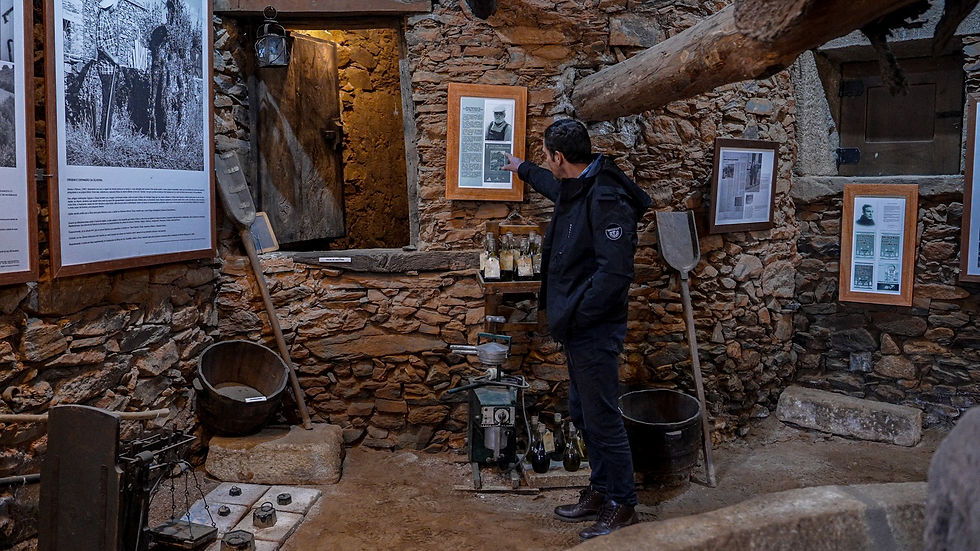
It all begins in the olive storage shed — a large area where the freshly harvested olives were piled up and left to rest for days. Yes, days. In a time when speed was not a virtue, the olives fermented slightly. They knew exactly when the fruit reached the ideal point for extraction.
From there, the fruit was removed with the barreler — a wooden tool worn by the touch of countless hands — and transported to the pulsating heart of the olive press: the large circular stone millstone.
The Dance of the Oxen and the Stone
It is impossible to stand before that massive millstone and not imagine the scene: two oxen harnessed together, walking in endless circles, while 200 to 300 kilos of olives were crushed under the relentless weight of the stone. The rhythmic sound of hooves on the ground, the slow creaking of the wood, the dense, bitter aroma of the green mass forming.

This was not just a technique—it was an ancestral choreography. The men constantly fed the mill with fresh olives, controlled the animals' rhythm, and observed the consistency of the paste. The knowledge resided in experienced eyes, in hands that touched the mass and knew, without measuring, when it was ready.
Once macerated, the dark paste was removed with a shovel and transported in a wooden trough to the pressing area. And here begins the truly ingenious part.
The Alchemy of the Mats
The mats—braided discs of esparto grass about a meter in diameter—were the secret to the separation. The olive paste was carefully distributed on each mat, layer upon layer, with a small wooden stick pressing and maintaining a stable structure.

When the tower of mats reached its maximum height, two robust men began the Herculean task of pressing the wooden press. They turned it, sweated, turned it again. Little by little, it began to trickle—first a timid trickle, then a steady stream of dense, aromatic liquid.
But what trickled down was not yet pure olive oil. It was a mixture of oil, plant water, and solid impurities. And it is here that the true art was revealed.
The Decantation System: Science Before Science
Observe the photographs of the olive press carefully: those channels carved into the stone, those various granite "pools" at different levels. It is a natural hydraulic decantation system that has worked for centuries without fail.
The pressed liquid flowed into the first trough (stone tank), where it received a revolutionary thermal treatment: hot water taken from a copper boiler, heated precisely with the already pressed pomace—zero waste, maximum efficiency. This heating helped to separate the oil from the water.
Then came the magic of density. The lighter olive oil floated to the top. The heavier water settled at the bottom. Solid impurities sank completely. Through a system of sluices and channels, the impurities were directed to an aqueduct that carried them to the bottom of the village, where residual fats were collected to make soap—again, zero waste.
The olive oil then went to a second vat, then to a third, each more refined than the last. It was successive decantation, purification through patience. In the last tank, the olive oil was clear, golden, ready to be measured in the old friction measures and distributed to the families.
The Hidden Wisdom in the Tools
Walking among the tools of the Cortiços olive oil mill is like reading a treatise on pre-industrial engineering. The hanging copper boiler, worn but still shiny in some areas. The wooden barrel, with its handle polished by thousands of uses. A wooden bowl carved from a single oak trunk. Hand-woven esparto grass mats, each knot a technical decision.
Each object was made to last generations. Each form had a reason for being. Nothing was by chance.
And maybe the most impressively: all this worked without electricity, without motors, without modern technology. Only with the empirical knowledge accumulated over centuries of trial, error, and careful observation of nature.
The Olive Oil Mill that Became a Memorial
This family olive oil mill ceased operations in 1953, when modernization arrived and the old methods were no longer economically viable. For decades it served as a straw warehouse — a common fate for so many ancestral spaces.
But in 1996, the family decided to give it a second life. Not as a superficial tourist attraction, but as a space of living memory. Each tool was preserved in its original place. Explanations are given with passion by those who know these stories from the inside. The natural light that enters through the small schist windows continues to illuminate the same corners it illuminated 150 years ago.
Today, the Olive Oil Museum Centre is part of the Protected Landscape of the Azibo Reservoir and can be visited by appointment. And it should be a mandatory visit for anyone interested in heritage, sustainability, or simply understanding where our food comes from.
What the Ancient Olive Oil Mills Teach Us
At Azeite Norte, we visit Cortiços not with romantic nostalgia, but with deep respect for these ancestral lessons. Yes, today we use modern technology that guarantees food safety, efficiency, and certified quality. But the principles remain the same:
Respect the fruit's time—even with fast processes, the olive has its right moment.
Cold extraction—excessive heat destroys aromas, as the ancients already knew.
Separation without chemicals—natural decantation is still the best way.
Zero waste—every part of the olive has value.
What has changed are the tools. What remains is the philosophy: making olive oil is an act of patience, knowledge, and reverence.
Visit Before the Stones Forget
If these words have sparked your curiosity to visit the Cortiços Olive Oil Mill, don't delay. These spaces come alive while they are visited, while the stories continue to be told, while some are dazzled by the complex simplicity of these techniques.

The village of Cortiços, which was once the county seat before Macedo de Cavaleiros, holds many other secrets—including an ancient open-air communal olive press. But it is in the Museum Centre that the story is told in full, preserved, almost palpable.
Prepare to smell the ancient stone, to touch the worn wood of the mats, to imagine the heat of the copper boiler and the effort of the men at the press. It is a sensory experience that no photograph can convey.
And when you hold a bottle of olive oil again, you will remember that within that golden liquid is condensed a wisdom of millennia.
Because there are memories that cannot flow down the aqueduct of oblivion.
📍 Núcleo Museológico do Azeite - Solar dos Cortiços
Cortiços Village, Protected Landscape of the Azibo Reservoir
Visits: by prior arrangement
Learn about our commitment to the olive-growing tradition of Trás-os-Montes at


Comments