
Cortiços Open-Air Communal Olive Press: A Unique Story

Cortiços Open-Air Communal Olive Press: A Unique Story
📍 Cortiços • Macedo de Cavaleiros • Geopark Terras de Cavaleiros • Protected Landscape of Azibo Reservoir
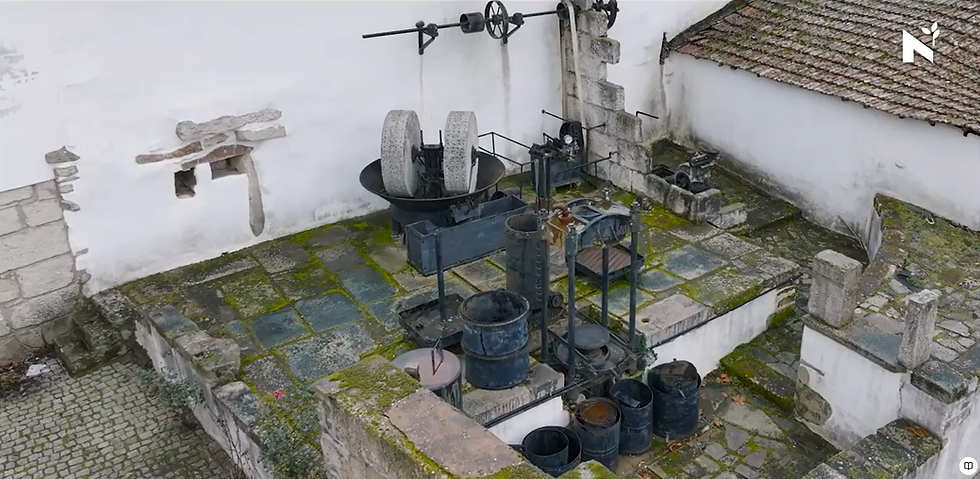
Some things only exist when an entire village decides they should. That olive trees belong to everyone. That work is shared. That the olive oil pressing from stone belongs to the community. In Cortiços, in the municipality of Macedo de Cavaleiros, one of those places survives: an open-air communal olive press that has outlasted time, administrative reforms, and abandonment — left to tell a story that no museum can contain within four walls.
This is not the Olive Oil Museum Centre — Solar dos Cortiços, which we have already explored in detail in a previous post. This is Cortiços' other secret — the one that stands in the open air, exposed to sun and rain, rooted in the ground like the olive trees themselves.
An olive press that belonged to everyone and was used by everyone.
Cortiços: when a village was a town
Those who pass through Cortiços today might not imagine that this village, with just over 230 inhabitants according to the 2021 Census (INE), was once a municipal seat until 1853 [1]. It had a royal charter, a courthouse, a prison, a civil registry. Above all, it had the grandeur of schist and granite manor houses that still dominate its central square.
In 1853, liberal administrative reforms absorbed Cortiços into the municipality of Macedo de Cavaleiros. The town lost its status, but not its memory. And it was that memory which preserved, among the outdoor stones and in plain sight of all, one of the rarest structures in Transmontano olive oil heritage: an open-air communal olive press — the place where, season after season, the harvest became sharing and individual labour dissolved into village solidarity.
What is an open-air communal olive press?
Unlike family mills such as the Solar dos Cortiços — sheltered inside schist buildings with copper boilers and dark wooden storage bins — the open-air communal olive press is a different kind of structure.
Its essence lies in stone and public square:
One or more circular granite millstones installed outdoors, connected by wooden beams turned by animals (usually oxen or donkeys) in continuous circles
Channels and stone basins carved to collect and naturally decant olive juice
Shared access space — any household in the community could use it, in scheduled turns managed by the local council or the village elders
Seasonal operation — active during the olive harvest from November to February, then silent and exposed to the seasons
This model has deep roots in Transmontano communal economy, well documented in villages such as Rio de Onor (in the same district of Bragança), where ovens, land and flocks were shared for centuries [2]. In Cortiços, that communal logic extended to the processing of olives. The land and the stone belonged to all.
🎥 A place and two olive oil presses in a picture.
What you can still see in Cortiços
Visiting Cortiços today means walking through layers of time without leaving the same square. The communal press stones coexist with the manor houses, with the former Town Hall, and with the granite and schist houses that refuse to abandon the architecture of the Monarchy [3].
Here is what can be observed:
Circular granite millstone — the central element of the open-air press, visible in the village's public space
Stone decantation basins — the natural system for separating olive oil and water
Schist manor houses — three manor houses evoking the time when Cortiços was one of the wealthiest villages in the district of Bragança [1]
Former Town Hall building — the courthouse, prison and civil registry still recognisable, now in private ownership [3]
Cortiços Railway Station — a historical marker of the Tua Line, whose Mirandela–Macedo de Cavaleiros section was suspended in 1991 [1]
To visit in combination with: the Olive Oil Museum Centre — Solar dos Cortiços (visit by prior arrangement; contact the Sá Miranda Patrício family), located at Largo do Coreto, Cortiços, Macedo de Cavaleiros.
What this press tells us about who we are
Azeite a Norte does not visit Cortiços with romantic nostalgia. We visit it with respect for a lesson in social organisation that modernity has yet to fully learn: that the individual and the collective can coexist, that sharing resources is not economic weakness but ancestral intelligence, and that olive oil pressed in common has a flavour that goes beyond chemistry.
At a time when the world is rediscovering circular economies, commons, and sustainability, the communal olive press of Cortiços presents itself as a 500-year-old prototype — a zero-waste production model, running on renewable energy (animal and human), without packaging, without logistics, without waste.
What changed were the tools. What remained was the philosophy.
How to visit and reach Cortiços
📍 Location:
Cortiços, Macedo de Cavaleiros, Bragança District
Coordinates: 41.5170° N, 7.0202° W
🚗 By car:
From Macedo de Cavaleiros: approx. 10 km via EN216. From Mirandela: via EN15 / EN216, approx. 30 km.
⏱ Recommended time in the village:
1.5 to 2 hours, including the open-air press and Solar dos Cortiços (prior booking required).
📅 Best time to visit:
November–February: olive harvest season in the municipality — the most alive context to understand the press
October–November: olives still on trees, golden foliage, autumn light
Spring (March–May): peaceful atmosphere, nature awakening, no crowds
🗺 In Azeite a Norte itineraries: Cortiços is part of the Macedo de Cavaleiros itinerary at azeiteanorte.pt/en/roteiros
Our visit tip
Go slowly. Sit on one of the terraces near the olive trees and look at the press stone without hurry. Imagine the olive harvest gathering — families arriving at dawn, oxen walking in circles, dark paste forming under the millstone's weight, the sharp green scent of fresh juice. Imagine the turns, the agreements, the arguments and the celebrations.
This is not museum tourism — it is living memory tourism.
And when you leave Cortiços, the olive oil you buy next will never taste quite the same.
💬 Have you been to Cortiços? Share your visit in the comments!
🔖 Save this article for your next itinerary through Northeastern Trás-os-Montes.
References
olive oil tourism Trás-os-Montes | communal olive mill Portugal | Cortiços Macedo de Cavaleiros olive oil | circular millstone outdoor | olive growing tradition TMAD


Comments